

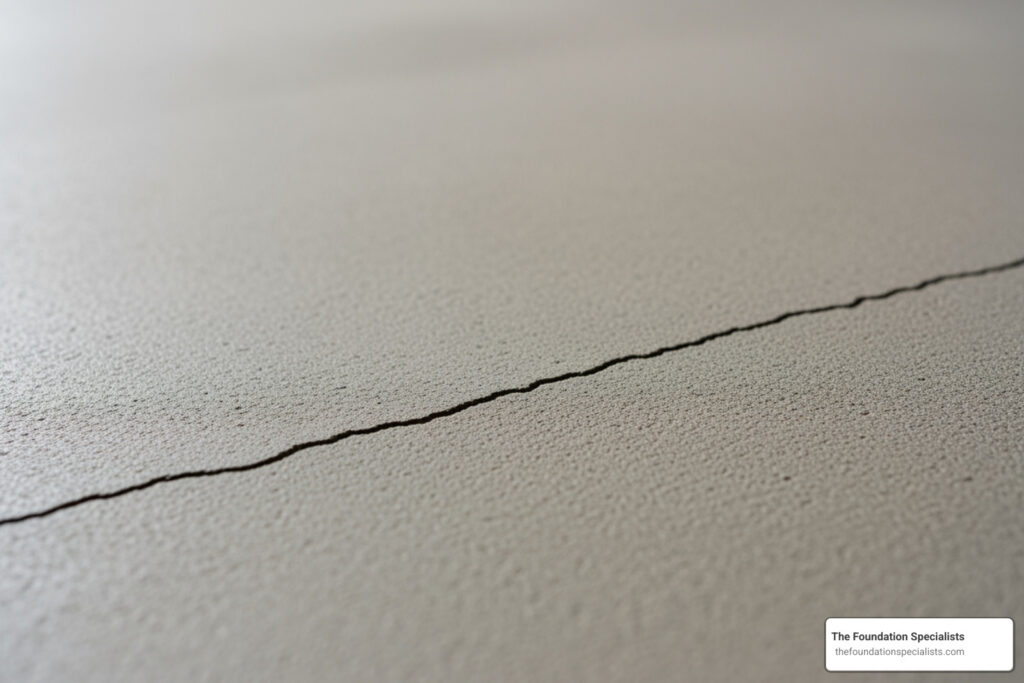
Why Homeowners Notice Hairline Cracks in Their Garage Floors
Hairline cracks in garage floor surfaces are one of the most common concerns homeowners face—and fortunately, they’re rarely as serious as they look. Here’s what you need to know:
Quick Answer:
- Hairline cracks (less than 1/8 inch wide) are typically cosmetic and caused by normal concrete shrinkage during curing
- They don’t usually indicate structural problems and won’t compromise your garage floor’s integrity
- You should worry if: the crack is wider than 1/8 inch, one side is higher than the other, the crack is growing, or it extends up your walls
- Simple repairs: Most hairline cracks can be sealed with epoxy or polyurethane products to prevent moisture intrusion
If you’ve recently spotted a thin crack running across your garage floor, you’re probably wondering whether it’s a sign of serious foundation damage or just a normal part of concrete aging. The good news is that the vast majority of hairline cracks are completely harmless—they’re simply the concrete’s way of relieving stress as it cures and settles.
That said, not all cracks are created equal. While hairline cracks are generally cosmetic, some cracks do signal underlying structural issues that need professional attention. The key is knowing how to tell the difference.
In this guide, we’ll walk you through everything you need to understand about hairline cracks in your garage floor. You’ll learn what causes them, how to distinguish harmless cracks from serious ones, and what you can do to repair and prevent them.
As Dylan Morris, Marketing Director at TFS – The Foundation Specialists, I’ve spent over a decade helping homeowners understand foundation and concrete issues, including the common concern of hairline cracks in garage floor surfaces. Through our work, I’ve seen countless homeowners unnecessarily worry about cracks that pose no structural threat, which is why clear education on this topic is so important.
What Are Hairline Cracks and Why Do They Appear?
Finding cracks in your garage floor can be intimidating, but it’s actually a very common occurrence. Concrete is a strong and durable material, but it’s also prone to cracking under various conditions. Most of the time, these cracks are superficial and don’t pose a threat to your home’s structural integrity.
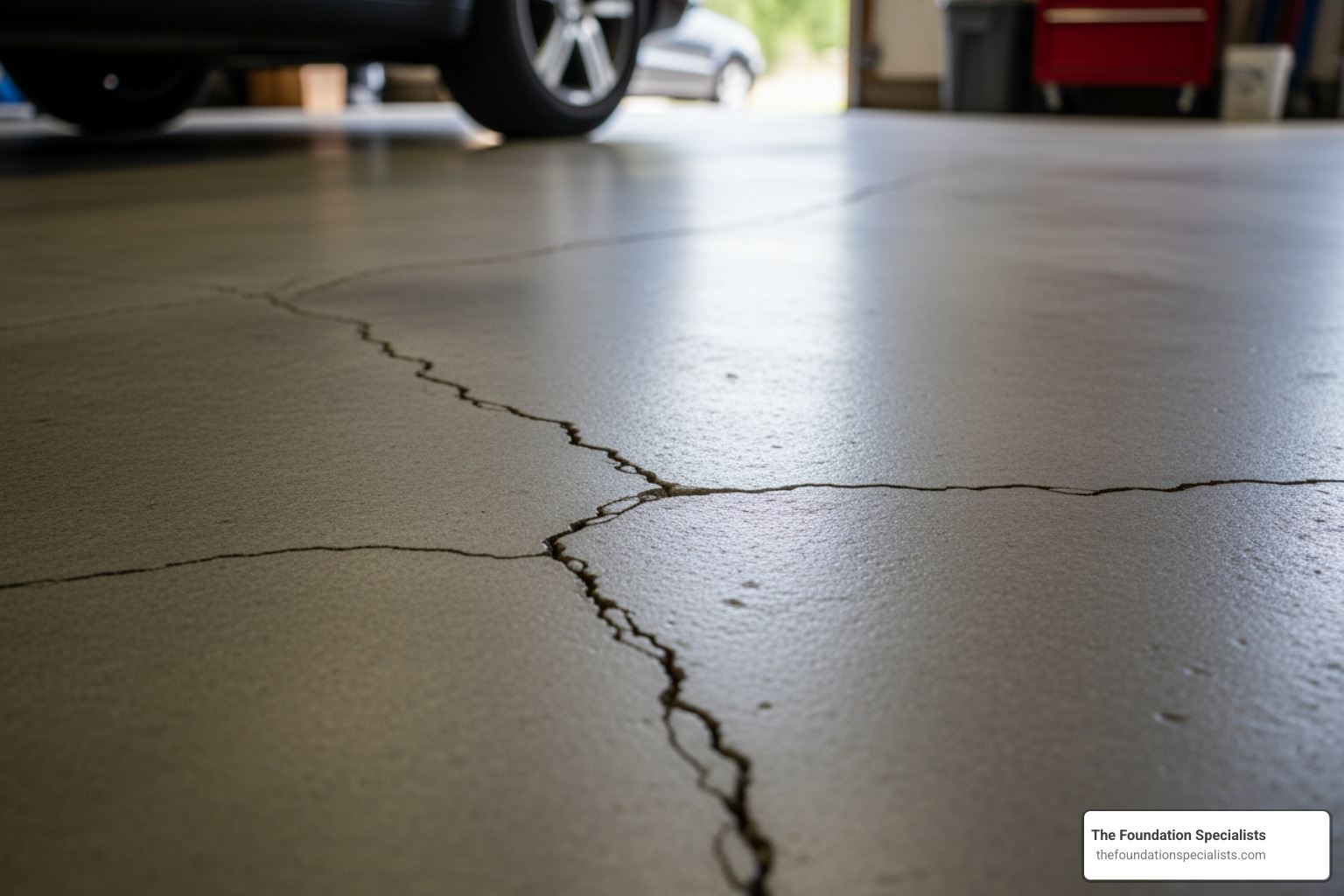
Defining Hairline Cracks
So, what exactly constitutes a hairline crack in a garage floor? Generally, we consider any crack less than 1/8 inch wide to be a hairline crack. These are typically very fine, surface-level cracks that don’t extend deep into the concrete slab. They are primarily a cosmetic issue, meaning they might not look great, but they usually don’t compromise the strength or safety of your garage floor.
Many modern homes, especially in our service areas of Tennessee, Alabama, Kentucky, and Indiana, feature “floating slabs” for garage floors. This means the concrete slab is poured independently of the main foundation, allowing it to move freely. This design can make garage slab cracks less likely to indicate major structural issues, as the slab is designed to have some independent movement.
Understanding the Causes of Hairline Cracks in a Garage Floor
Hairline cracks in garage floor surfaces often have very natural and common explanations. Understanding these causes can help alleviate concern and inform your approach to repair.
-
Concrete Shrinkage: This is by far the most common culprit. As concrete dries and cures, it naturally shrinks. This shrinkage creates internal stresses within the slab, which can lead to small cracks on the surface. These shrinkage cracks are usually considered a normal part of the curing process and don’t affect the structural integrity of the floor. They typically appear within the first few months to a year after the concrete is poured.
-
Rapid Drying (Crazing): Sometimes, if the concrete dries too quickly, especially in hot or windy conditions, it can lead to very fine surface cracks known as “crazing.” These cracks often resemble an irregular honeycomb pattern or a cracked desert floor. While unsightly, crazing is almost always cosmetic and not a sign of serious structural damage.
-
Temperature Fluctuations: Concrete, like most materials, expands when it gets warm and contracts when it gets cold. These constant temperature changes cause the concrete slab to move. If the slab doesn’t have adequate room to expand and contract (for example, if control joints are missing or improperly spaced), these stresses can manifest as hairline cracks in the garage floor.
-
Improper Concrete Mix: While less common for purely hairline cracks, a concrete mix that is too wet or has an incorrect water-to-cement ratio can contribute to cracking. A wetter mix can lead to more shrinkage during drying, increasing the likelihood of surface cracks.
Hairline vs. Structural: How to Tell the Difference
Distinguishing between a harmless hairline crack in a garage floor and a more serious structural crack is crucial for any homeowner. While most hairline cracks are nothing to worry about, knowing the red flags can help you determine when it’s time to call in the professionals.
Signs of a Harmless Hairline Crack
If you’ve found a crack in your garage floor, take a moment to assess it. A truly harmless hairline crack will typically exhibit these characteristics:
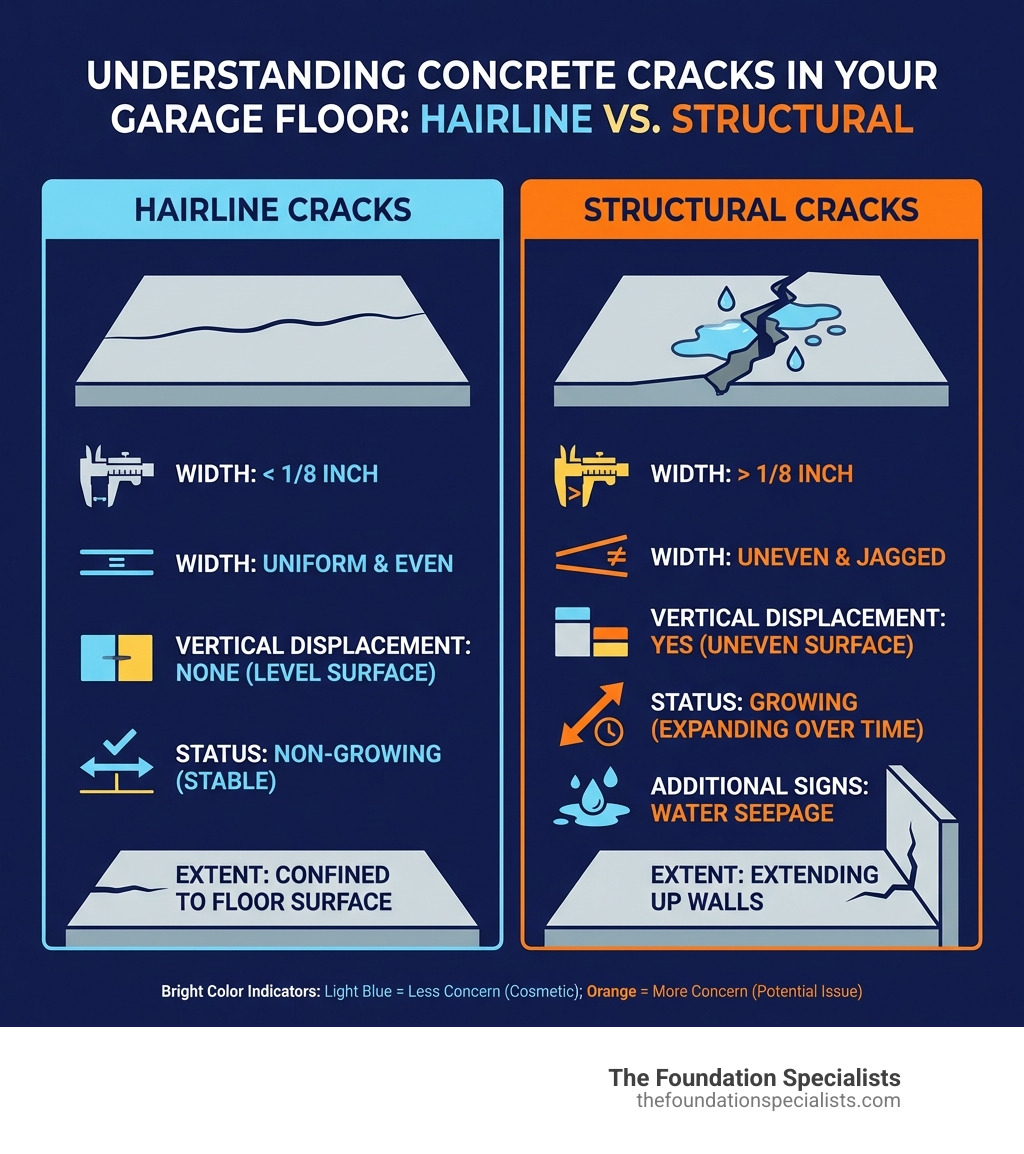
- Width Less Than 1/8 Inch: As we’ve discussed, this is the defining characteristic of a hairline crack. If it’s narrower than 1/8 inch, it’s very likely a non-structural crack caused by shrinkage during the curing process.
- Consistent Width: The crack should maintain a relatively uniform width along its entire length. It shouldn’t be significantly wider in one section than another.
- No Vertical Displacement: Both sides of the crack should be level with each other. You shouldn’t be able to feel one side raised higher than the other when you run your hand across it.
- Not Growing: While it’s a good practice to monitor any crack, harmless hairline cracks typically don’t grow significantly in length or width over time. You can mark the ends of the crack with a pencil and measure its width periodically to confirm it’s stable.
- No Water Exposure: If these minor cracks are not exposed to water, they are even less likely to widen or worsen.
Red Flags of a Structural Problem
While hairline cracks in garage floor surfaces are usually benign, certain signs indicate a more serious underlying issue. These are the cracks that warrant closer inspection and potentially professional intervention.
| Feature | Harmless Hairline Crack | Structural Crack |
|---|---|---|
| Width | Less than 1/8 inch | Wider than 1/8 inch (or even 1/4 inch or more) |
| Height | Both sides are level | One side is raised or lower than the other (vertical displacement, heaving, or settling) |
| Progression | Stable, not growing | Growing in length or width, or showing movement |
| Pattern | Often straight or random, but isolated | Irregularly sized, jagged, spreading across the entire floor, or forming a network of intersecting cracks |
| Location | Anywhere on the slab, but not extending beyond | Extending up the garage walls, across control joints, or concentrated in areas indicating foundation stress |
| Water Presence | No active water seepage | Water actively seeping through the crack, especially if accompanied by efflorescence (white mineral deposits) |
| Other Symptoms | None | Sloping floors, difficulty opening/closing garage doors or windows, pooling water in the garage, cracks in other parts of the house (walls, steps, foundation), sagging roofs, or visible cracks in the home’s foundation. |
| Underlying Cause | Concrete shrinkage, rapid drying, minor temperature stress | Differential foundation settlement (uneven settling of the foundation), expansive soils, poor soil compaction, heavy loads exceeding design capacity, severe freeze-thaw cycles causing soil heaving, or major water issues leading to soil erosion beneath the slab. |
If you observe any of the “Red Flags” listed above, particularly cracks wider than 1/8 inch, uneven slab portions, or cracks extending up the walls, it’s a strong indication of a deeper problem like foundation settlement. Differential foundation settlement, where the soil underneath your foundation shifts or compresses unevenly, is a primary cause of structural cracks and requires prompt professional attention.
Your Guide to Repairing Hairline Cracks in a Garage Floor
Addressing hairline cracks in garage floor surfaces isn’t just about aesthetics; it’s also about preventing potential future problems. Even minor cracks can allow moisture to penetrate the concrete, which, over time, can lead to bigger issues.
Simple Repair Options for Minor Hairline Cracks
For most hairline cracks in garage floor surfaces that are less than 1/8 inch wide and show no signs of being structural, a do-it-yourself repair is often sufficient. This can prevent water intrusion, improve the floor’s appearance, and stop the crack from worsening due to freeze-thaw cycles.
Here’s how we recommend tackling minor cracks yourself:
-
Clean the Crack Thoroughly: This is a crucial first step for proper adhesion.
- Use a wire brush, screwdriver, or utility knife to scrape out any loose debris, dirt, or old caulk from within the crack.
- For stubborn dirt or grease, scrub the area with a degreasing solution and water.
- Use a shop vacuum, leaf blower, or compressed air to remove all remaining dust and particles.
- Ensure the crack is completely dry before proceeding.
-
Prepare the Crack (if needed): For cracks slightly wider than a true hairline (say, up to 1/4 inch), some products might recommend “undercutting” the sides to create an inverted ‘V’ shape. This helps the filler adhere better and creates a stronger bond. However, for very fine hairline cracks, this step is usually unnecessary.
-
Choose the Right Filler/Sealant:
- Epoxy or Polyurethane Sealants: These are excellent choices for hairline cracks in garage floor surfaces. They are flexible, durable, and form a strong bond. Many are sandable, allowing for a smoother finish. Epoxy injection is a common and effective solution for non-structural shrinkage cracks, as it fills and strengthens the concrete.
- Polyurea: This is a fast-setting, semi-rigid repair liquid that not only seals but also reinforces and strengthens the concrete. It’s a robust option for cracks that might see some movement.
- Concrete Caulk: A polymer-based concrete caulk is a simpler option for sealing cracks, especially if some concrete movement is expected. However, some caulks may not be sandable or paintable, so check the product specifications if aesthetics are a concern. Avoid water-based or latex-based fillers for garage floors, as they tend to be temporary and can shrink.
-
Apply the Filler:
- Follow the manufacturer’s instructions carefully, as mixing and application can vary by product.
- Apply the filler evenly into the crack, ensuring it penetrates deeply. A caulk gun or a small putty knife can be helpful.
- For wider cracks (over 1/4 inch), you might need a concrete backer rod inserted into the crack before applying the filler. This minimizes the amount of filler needed and ensures a more uniform repair.
- If the crack is deeper than 1/2 inch, some patching compounds require application in 1/4 inch layers, allowing each layer to dry before adding the next.
-
Finish and Cure:
- Immediately after application, smooth the excess filler with a wet trowel or putty knife to match the surrounding concrete surface.
- Allow the repair to cure fully according to the manufacturer’s instructions. This might take several hours to a few days, depending on the product and environmental conditions. We always recommend waiting until the forecast calls for dry weather and the concrete surface temperature is at least 50 degrees Fahrenheit before making repairs.
DIY fixes for small cracks can cost anywhere from $50 to $200, making them a cost-effective solution for homeowners.
When to Call a Professional
While many hairline cracks in garage floor surfaces can be handled with DIY methods, there are definite instances when professional help is not just recommended, but necessary. Our team at The Foundation Specialists has over 20 years of trusted experience in comprehensive home repair services across Tennessee, Alabama, Kentucky, and Indiana, and we know when a crack signals something more serious.
You should call a professional if you observe any of the following:
- Structural Red Flags: Any of the “Red Flags of a Structural Problem” we discussed earlier (cracks wider than 1/8 inch, uneven heights, rapid growth, water seepage, cracks extending up walls, or multiple intersecting cracks) should prompt a call to us. These are often signs of significant differential foundation settlement.
- Uneven Slabs: If sections of your garage floor are noticeably uneven, sinking, or heaving, this indicates subgrade issues that require specialized repair techniques like slab leveling or foundation underpinning. For instance, if one side of a crack is higher than the other, it’s a strong indicator of movement that DIY fillers cannot address.
- Water Issues: Persistent water pooling in your garage, especially if it seems to be seeping up through cracks, points to underlying drainage or moisture problems that need expert assessment and solutions, such as a drain tile system.
- Uncertainty: If you’re simply unsure about the cause or seriousness of a crack, it’s always best to err on the side of caution. We offer professional assessments to accurately diagnose the problem.
- Desire for a Perfect Finish: While DIY repairs can be effective, achieving a seamless, professional finish, especially if you plan to apply an epoxy coating, often requires the expertise and specialized tools of a professional.
Bigger damage, particularly structural issues, can cost over $1,000 to fix, and major repairs like slab leveling or full replacement can run into thousands. When you choose The Foundation Specialists, you benefit from our professional execution, ensuring long-lasting, high-quality results.
Long-Term Care and Prevention
Preventing hairline cracks in garage floor surfaces, or at least mitigating their severity, involves a combination of good construction practices and ongoing maintenance. Proactive measures can save you time, money, and stress in the long run.
Preventing Cracks in a New Garage Floor
If you’re planning a new garage or concrete slab, ensuring proper installation is your best defense against cracking:
- Proper Soil Compaction: A well-compacted subgrade is fundamental. If the soil underneath the slab isn’t properly compacted, it can settle unevenly over time, leading to cracking.
- High-Quality Concrete Mix: Use concrete with the correct water-to-cement ratio and high-quality aggregates. A mix that is too wet can increase shrinkage and the likelihood of cracking.
- Adequate Reinforcement: Rebar, wire mesh, or other strong materials should be used to reinforce the concrete slab. This helps the concrete resist tensile stresses that cause cracking and holds any cracks tightly together.
- Slow Curing Process: Concrete needs to cure slowly and evenly to gain strength and minimize shrinkage cracks. This means keeping the concrete moist for the first few days or even weeks after pouring. In hot, dry weather, this might involve spraying the surface with water several times a day. In colder temperatures, an insulating blanket can protect it.
- Use of Control Joints: Control joints are intentionally placed grooves or cuts in the concrete slab. These “weak spots” encourage any cracking that occurs due to shrinkage or thermal expansion to happen along these planned lines, rather than in random, unsightly patterns. If your garage floor does not have expansion and control joints, it’s more susceptible to random cracking. Learn more about control joints.
Maintaining Your Existing Garage Floor
For existing garage floors, ongoing care can significantly reduce the likelihood of new cracks forming or existing ones worsening:
- Applying a Concrete Sealer: A high-quality concrete sealer protects the surface from moisture, chemicals, and de-icing salts. Applying a sealer every few years creates a protective barrier, preventing water from penetrating existing cracks and exacerbating them through freeze-thaw cycles.
- Managing Water Drainage: Water is concrete’s worst enemy. Ensure your yard slopes away from your garage foundation (a minimum 2% slope is recommended). Install downspout extensions to channel rainwater far away from the foundation. Clean your gutters regularly (at least twice a year) to prevent overflows that saturate the soil around your garage. These measures help prevent soil erosion and settlement that can lead to structural cracks.
- Avoiding Heavy Loads: While garage floors are designed for vehicles, consistently overloading them beyond their intended capacity with extremely heavy equipment or multiple vehicles can stress the slab and lead to cracking.
- Sealing Small Cracks Promptly: Even if a hairline crack in a garage floor is minor, sealing it quickly prevents water and debris from entering. This is especially important in areas with freeze-thaw cycles, as water trapped in a crack can freeze, expand, and widen the crack over time.
Frequently Asked Questions about Garage Floor Cracks
Are hairline cracks in a garage floor normal?
Yes, absolutely! Hairline cracks in garage floor surfaces are very common and, in most cases, completely normal. Concrete shrinks as it dries and cures, and this natural process often results in small, surface-level cracks. These are usually cosmetic and do not affect the structural integrity of your garage floor. They are often considered an expected part of the concrete’s aging.
What happens if I ignore hairline cracks?
Ignoring hairline cracks in garage floor surfaces can lead to a few potential issues, though not always serious ones. For purely cosmetic cracks, the main consequence might be that they collect dirt and become more noticeable. However, if unsealed, water can seep into these cracks. If you live in an area with freeze-thaw cycles, this trapped water can freeze and expand, potentially widening the cracks over time. Additionally, if you live in a radon-prone area, there’s a chance that radon gas could seep through cracks in your garage floor and into your home. You can find out more about local radon zones on this US Environmental Protection Agency site.
Can I put a coating over hairline cracks?
You can put a coating over very fine hairline cracks in garage floor surfaces, but there are important considerations. Epoxy coatings, for example, can hide minor cracks, but they will not fill or bridge more serious ones. If the crack is wider than a true hairline, or if there’s any movement, the crack can “telegraph” through the coating, meaning the imperfection will eventually become visible through the new surface. For the best and most durable results, we always recommend properly repairing any cracks before applying a coating.
Protect Your Foundation and Your Peace of Mind
Understanding hairline cracks in garage floor surfaces is about knowing when to be concerned and when to simply maintain. Most hairline cracks are a normal and harmless part of concrete, a testament to its natural processes. However, being able to identify the red flags of a more serious structural issue is key to protecting your home.
We at The Foundation Specialists are committed to helping homeowners throughout our service areas in Tennessee, Alabama, Kentucky, and Indiana. With over two decades of experience, we provide trusted foundation, concrete, crawl space, and basement solutions. If you have concerns about your garage floor, whether it’s a persistent hairline crack or a more significant issue, don’t hesitate to reach out.
Get a professional concrete assessment from our experts today, and let us help you ensure the safety and longevity of your home.